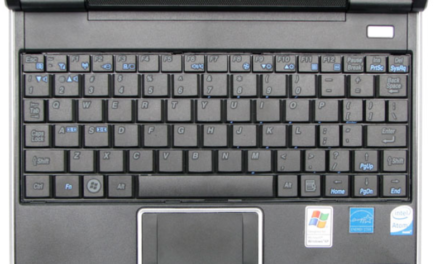
There has been a myriad of names for this Fujitsu model; it’s called the Lifebook U810 right here in the US, the Lifebook FMV U8240 when it was first released, the loox in Japan, and the U1010 in Southeast Asia. But don’t be misguided; it is the same netbook all throughout. Let’s take one last look back at one of the first units to get into the netbook world.
(Rather than switch from name to name, I’ll just call it the Fujitsu u810 for now)
The U810 is a conglomerate of black and white – not exactly very stylish, but it works well enough. Apart from this color scheme, what is most notable about the Fujitsu is its convertible property. It was effectively the first of its kind to turn into a tablet.
The U810 only weighed 600 grams, and was about as big as your paperback book, making it easy to move around. Today’s units are still heavier by comparison, save for a few select models.
 Like many tablets, the U810 can only swing one way. The hinge is sturdy enough, though, so you don’t have to worry about it breaking early unless you abuse it. And as for the screen, it is very bright legible.
When the unit is sitting on a desk, you can easily manoeuvre within by using your fingertips. The touch pad is remarkable, and I assure you that you will have a lot of fun with it.
While the tablet form is really fun to use, I have to dismally say that the keyboard is next to unusable. It really can’t be helped, and Fujitsu should be praised by getting a 66% full-sized QWERTY keyboard in, but it is just physically impossible to add anything bigger. If you are a touch-typist, avoid the U810 as much as you can.
The specs are what you’d expect a netbook from two years ago to be; it has a 40GB hard disk, a 1GB RAM, and an 800MHz Intel processor. These are now low by today’s standards, and I wouldn’t suggest getting it. It’s just a fun device to reminisce on, but if you want a more modern version of it, then I suggest the upcoming Fujitsu 2010. I will review that model the first chance that I get.